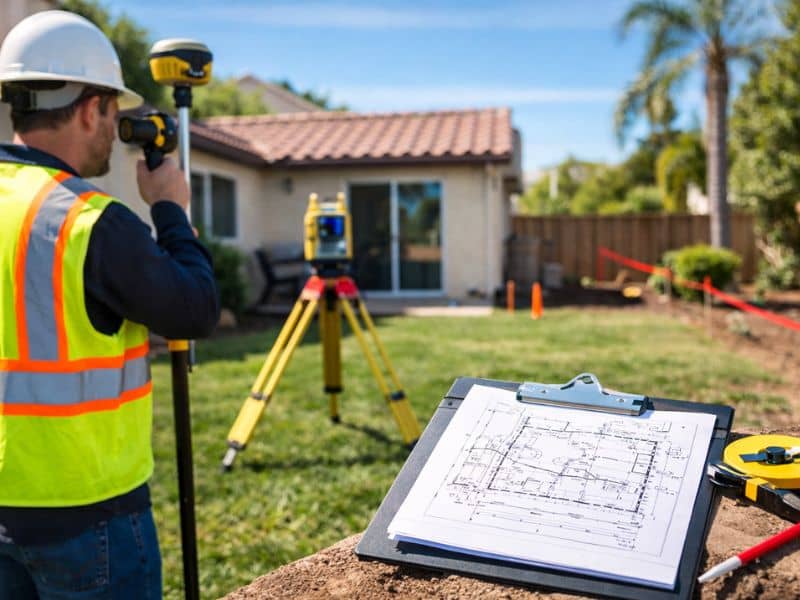
Planning a property improvement in San Diego often starts with design ideas, layout, and budget. But before any of that moves forward, it’s important to understand what your land actually allows. This is where a lot survey becomes essential, helping property owners confirm boundaries, space, and layout before committing to plans that may not fit the site.
Many owners begin a project by thinking about square footage, layout, or cost. Those are important, but they come after a more basic question: what does the lot actually allow? A lot survey helps answer that by showing the dimensions and layout of the parcel as it exists on the ground.
That matters in San Diego because property improvements often happen on tight sites. Some lots look larger or more flexible than they really are. Others have shapes, access points, or existing conditions that affect where new work can go. City ADU guidance also notes that some rules are not effective in the Coastal Overlay Zone, which means site-specific review matters even more in certain areas.
Without reliable lot information, owners can spend time and money designing something that later needs to move, shrink, or change. A project may look workable on paper but fail once actual dimensions and site limits are verified.
A lot survey does more than show a rough outline. It gives owners a clearer picture of the property they are planning to improve. That includes lot dimensions, boundary relationships, and the spatial conditions that can affect placement decisions.
For homeowners thinking about an ADU, expansion, or other site changes, that clarity matters because official San Diego guidance ties development standards to specific site conditions and structure types. The city’s ADU bulletin explains that regulations vary depending on the kind of ADU and where it is placed, while the Housing Action Package reflects the city’s broader push to create more housing opportunities.
In practical terms, a lot survey helps answer questions like these. How much room is there between the existing home and the property line? Is the side yard as wide as it seems? Is there enough space to place a detached structure where you want it? Those are not small details. They shape what is realistic before design goes too far.
One of the most important reasons to order a lot survey is to understand usable space. Owners often assume that if part of the yard looks open, it is available for building, but that is not always the case.
San Diego regulations and ADU guidelines make placement decisions more precise. Setbacks, height limits, and structure types all affect where improvements can go. This is why many property owners rely on clear and accurate land survey solutions to understand how much space they actually have before moving forward with design.
With verified measurements in place, it becomes much easier to plan confidently. Instead of guessing where structures might fit, your design team can work with reliable data that reflects real conditions on the property.
This helps avoid the common mistake of designing around assumed space instead of confirmed lot dimensions.
Project delays often begin with an assumption that turns out to be wrong. A fence may not sit where the owner thinks it does. A side yard may narrow more than expected. An existing improvement may affect available space in ways that are not obvious until measured.
Once that happens, the project can slow down fast. Plans may need to be revised. Placement may need to shift. In some cases, owners discover late in the process that their preferred layout was never realistic for the lot.
This is especially important in a city that continues to adjust housing rules. San Diego’s Housing Action Package 2.0 was approved in December 2023, and the city later issued updated ADU materials in 2025 and 2026. That kind of active regulatory environment means owners benefit from starting with current information and a clear understanding of the property itself.
A lot survey does not replace design or permitting, but it improves both. It gives owners and professionals a shared reference point before bigger commitments are made.
If you are planning to build, expand, or rework part of your property, it makes sense to verify the lot first. That step helps you understand what the site can support before you invest in drawings, schedules, or construction plans.
This is not just about large projects. Even modest property changes can run into trouble when dimensions, setbacks, or site relationships are assumed instead of confirmed. In San Diego, where housing activity and ADU interest remain strong, accurate lot information helps owners move forward with more confidence.
A lot survey gives you a stronger starting point. It helps align your plans with the property on the ground, not just your expectations. That can reduce redesigns, support smoother conversations with design professionals, and make the next step in your project much clearer.
For many property owners, the smartest move is to get clarity early. When the lot is understood first, the rest of the project tends to make more sense.