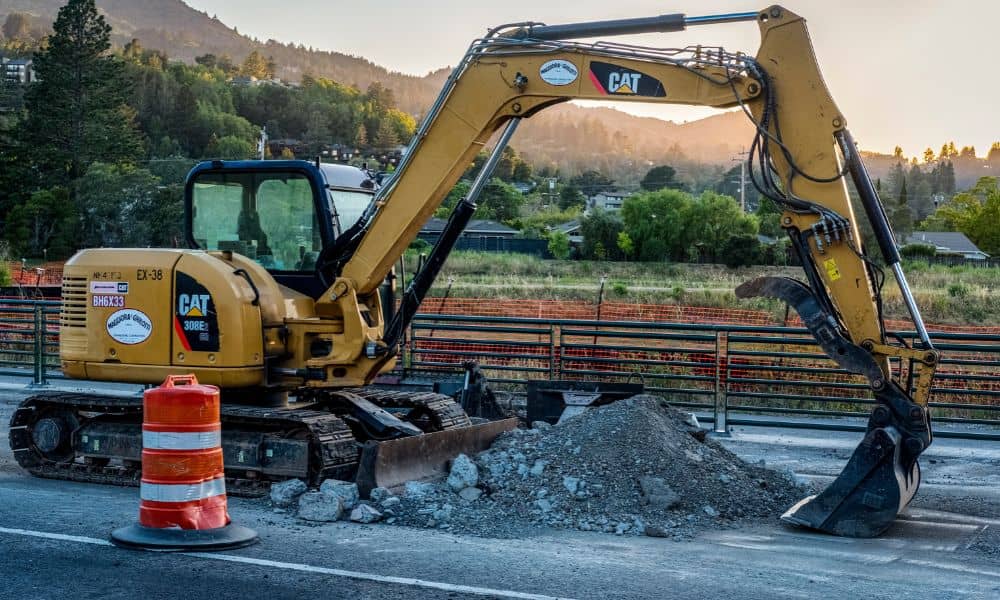
Fixing a highway slope leaves little room for guessing. Crews work next to moving traffic, and the damaged ground may still shift. The new slope has to match the engineer’s plan closely so it holds up for years. A construction survey gives the crew and the engineer the same set of measured points, lines and grades to build from. At the end, it also records what the crew really built.
Around Sacramento, much of this work takes place on the State Highway System. Caltrans pays for repairs, emergency repairs and safety work through a program called SHOPP. Its guidance also covers how crews rebuild failed slopes and add slope protection. Contractors on these jobs report to state inspectors and engineers, so the survey numbers need to hold up when someone checks them. The sections below walk through each step, from the first control points to the final record.
Survey control is a set of fixed points with known locations and heights. Every stake and grade check on the job ties back to these points. On a highway slope repair, the surveyor usually starts with the control points on the plans and checks them in the field first.
Busy highways make these points hard to protect. Traffic, closed shoulders and big machines all share the same thin strip of ground. That’s why surveyors often set control on firm ground away from the repair area. A point placed too close to the failed slope can slide with the soil. Then every measurement tied to it would be off too.
Access matters as well. Crews may only reach some points while a lane or shoulder is closed, so the surveyor plans field work around those time slots. Extra backup points help a lot here. If a machine knocks out a marker, the crew can reset it fast.
Before digging starts, the surveyor marks the edges of the repair on the ground. These marks show where digging or filling starts and stops. They also show where the new slope meets solid ground and how close the work gets to the state’s property line. Clear edges keep the crew from digging too far or stopping too soon.
Slope stakes handle much of this job. A slope stake marks the catch point. That’s the spot where the planned slope meets the ground that’s already there. The stake lists how deep to dig or how much to fill, plus how steep the slope should be. With this, the machine operator knows what the finished slope should look like.
Failed slopes make this step harder. The ground may have sunk, cracked or bulged since the first survey, so catch points often land in a different place than the plans show. When the ground no longer matches the plan, the surveyor should tell the engineer before digging starts. That early heads-up lets the engineer change the edges instead of changing course halfway through the job.
Most slope repairs include more than new dirt. The plan might call for a retaining wall, a soil nail wall or rock slope protection. It might also add underground drains, surface drains or new pipes under the road. The surveyor marks where each piece goes and how high it sits, so everything fits the way the engineer drew it.
Common items a surveyor marks on these jobs include:
Drains need extra care because water often causes the slope to fail in the first place. A drain only works if it moves water downhill at the planned grade to a safe outlet. A small grade mistake can trap water behind a wall or inside the new slope. Over time, that water can undo the repair. Checking pipe grades before the crew buries them makes any fix much easier.
Slope repairs rarely go exactly as planned. Crews may dig into soft soil, buried junk, leaking water or rock the plans didn’t show. Winter storms can also wash away a fresh slope before the crew finishes it.
The surveyor checks grades as the work moves along. This might mean spot checks on the slope face or checks on each new layer of fill. The surveyor may also take cross sections at set stations. Stations are distances measured along the center of the highway, and they give everyone the same way to name a spot on the job.
When the slope starts to drift from the plan, these checks catch it early. The crew can trim or add dirt before the next layer covers the mistake. If the engineer changes the plan because of new ground conditions, the surveyor needs the new plans before resetting stakes. Building from old plans after a change is one of the quickest ways for a slope repair to go wrong.
An as-built survey records where the finished work sits and how high it is. On a slope repair, it usually covers the finished slope, the wall location and height, pipe inverts and drain outlets. An invert is the inside bottom of a pipe, where the water flows.
This record does more than one job. Engineers and inspectors use it to see if the work matches the plan or where it differs. Road crews can pull the same data years later if the slope starts to move again. Some contracts also use survey data to count how much dirt or rock the crew placed.
What the as-built needs to include depends on the contract, the agency and the engineer. Contractors should ask about the file format, the coordinate system and the due date before the job starts. Waiting until the end can cause trouble. Measuring drains and footings while they’re still open is far easier than guessing about buried work later.
Can construction surveying continue while part of a highway remains open?
Yes, in most cases. Survey crews often work inside the same closed lane or shoulder the contractor uses. The timing depends on the agency’s traffic rules and the closure schedule, so survey work should go into that schedule from the start.
What happens when survey stakes are disturbed during slope repair?
The crew should stop using that stake and ask for a new one. The surveyor can reset it from the control points or offset stakes, which is why those points need protection all through the job. Building from a stake that moved even a little can put a wall, drain or slope in the wrong place.
Can machine control replace construction survey staking on slope repairs?
It can cut down on stakes, but it doesn’t replace survey work. Machine control uses a 3D model and satellite or laser tools to guide a machine’s blade or bucket. Someone still has to build the model, set and check the control points and measure the finished grades. The project specs decide how many physical stakes the job still needs.