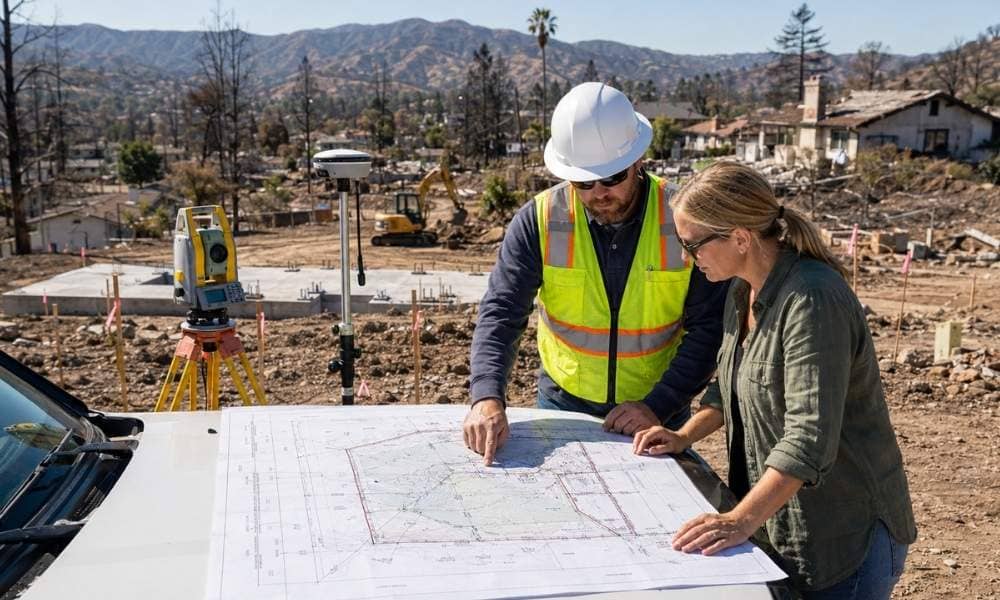
Rebuilding after a wildfire is not like building on an empty lot. The land looks different. Old markers are gone. And Los Angeles has fast-track rules to help you rebuild sooner. But those rules only work if your paperwork is correct from the start.
A boundary survey is one of the first steps that keeps a rebuild on track. Skip it, guess at it, or use an old one, and you could lose weeks waiting on your permit. Here is what developers and homeowners need to know before they turn in their plans.
Before a fire, most people never think about where their property lines are. They just look at the fence. They look at where the driveway stops. They look at the old shed in the corner.
After a fire, those markers are often gone. Wood fences burn. Plastic stakes melt. Even metal pins can move when the ground gets very hot and then cools fast during a big fire.
This means many rebuilds start with less certainty than the first build had. The old signs that once made property lines clear are no longer there. A licensed surveyor has to go back to deeds and old survey maps. They also look for any markers still left in the ground. This helps them find the real corners of the lot.
For developers working on many burned lots, this step cannot be skipped. Guessing at a line, even by a few inches, can cause problems later. It can affect setbacks, permits, or even your neighbor’s rebuilding.
After the Palisades and Eaton fires, cleanup crews moved fast. The U.S. Army Corps of Engineers cleared debris from private lots in the Palisades area in under a year. That was much faster than planned.
Fast cleanup is good news for rebuild timelines. But heavy machines do not know where your property line is. The same equipment used to clear ash and burned material can also move, bury, or destroy the survey markers left after the fire.
This is something many owners do not think about. Then their surveyor shows up and cannot find a corner marker that used to be there. It is not anyone’s fault. It is just a side effect of fast, large-scale cleanup work. A new boundary survey fixes this problem. The surveyor uses deed records, not just ground markers, to set the lines again.
Los Angeles built a fast system to help people rebuild. The City opened a One-Stop Rebuilding Center in West LA. The goal is to finish the first plan check within 30 days. By late 2025, the City said rebuild permits were moving almost three times faster than before the fires. Over 70% of standard permit steps were no longer needed for many single-family homes.
But that speed only works if your application is complete when you send it in. Plan checkers need clear lot lines and setbacks before they can say yes to your project. This is true whether you are rebuilding the same home or a new design.
If your boundary lines are unclear or based on old, wrong information, your project can get pulled out of the fast line. It then goes into a slower, standard review.
For developers with more than one lot, a fresh boundary survey on each property removes one of the top reasons a file gets flagged. It is one small step. But it protects a fast timeline.
Many owners want to change their home while they rebuild. Maybe they want more space. Maybe they want to add a second floor or a small guest unit.
The City’s rules let you rebuild fast if your new home stays within 110% of the size, height, and use of the old one. Go past that, and you enter a slower, more detailed review. This includes new checks on setbacks and easements, even if your old home was built years ago under older rules.
This matters because many older homes in fire areas were built closer to the property line than today’s rules allow. They were “grandfathered in” under old zoning. A boundary survey shows exactly where your new home can legally sit. This way, your design team is not guessing while drawing the plans.
For developers, this step should happen early. It is much cheaper to fix a design on paper than after the City rejects your plan.
Getting money for a rebuild is not the same as funding new construction on a clear lot. More insurers and lenders now ask for an updated boundary survey before they release funds. This is a separate step from any survey used for your original home loan.
Why? Because the fire, plus the cleanup work, can create real doubt about where the property lines actually sit today. Lenders want that doubt cleared up before they put money into a specific building plan.
A current boundary survey gives lenders and insurers clear proof of where your property lines are right now, not where they were guessed to be before the fire. For developers handling money across several properties, having this document ready can help avoid delays at the exact time when speed matters most.
Rebuilding after a fire already has enough unknowns. Property lines should not be one of them. A current boundary survey gives developers, lenders, and city reviewers the same clear picture of a lot. That keeps plans moving instead of sitting in a review pile.
If you are rebuilding in a fire-hit part of Los Angeles, book your boundary survey early. It is one of the few steps in this whole process that you can fully control.