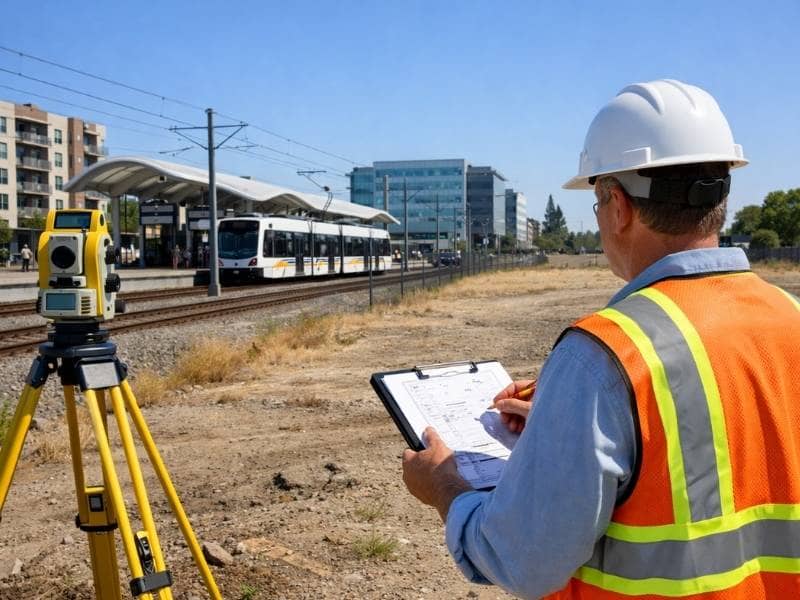
Land near public transit is in high demand. California SB 79 is making it easier to build higher-density housing close to transit stations, so more buyers are looking at sites near rail lines and transit hubs. These properties can be good opportunities. But they often come with conditions that are not easy to spot without the right tools. An ALTA survey helps buyers understand what they are getting before they make a decision.
This article explains how an ALTA survey supports the review of transit-oriented development sites and why that information matters throughout the buying process.
Sacramento’s transit network is growing. New stations are opening, and existing lines are expanding. That growth is pulling buyers and developers toward land near those stations. California SB 79 speeds things up even more by making it easier to get approvals for qualifying projects near transit. As a result, good parcels near transit hubs are getting harder to find.
But these sites are not always simple. Many of them sit where old development, public infrastructure, and recorded property rights overlap. A parcel that looks clean on a map might carry utility easements, transit authority buffers, or shared access rights that limit what a buyer can build.
A standard boundary survey shows where a property ends. An ALTA survey does more than that. It documents the physical conditions on the site and connects them to the recorded rights attached to the property. That gives buyers a clear, accurate picture before they commit.
The ALTA survey and title commitment work together as a pair. The title commitment reviews public records. The ALTA survey checks what is physically on the property. When buyers look at both together, they get a fuller picture of what they are actually buying.
On transit-oriented development sites, that combination can reveal things like:
Each of these can change how a project gets designed and where it can sit on the site. Finding them before closing gives buyers, architects, and lenders time to adjust their plans. Finding them after closing is more expensive and harder to work around.
Transit-oriented sites usually share edges with other parcels, public walkways, and sometimes transit facilities. Those shared edges matter.
An ALTA survey documents what is visible on and near the property. That includes shared driveways, parking areas with legal obligations attached, paths or sidewalks that cross the boundary, and structures that sit near or beyond the property line. It can also show where a neighbor’s improvement extends onto the subject lot, or where the subject property crosses into an adjacent parcel.
Catching these conditions during due diligence keeps a project on track. A shared curb cut tied to a recorded access agreement, or a retaining wall that belongs to the neighboring owner, will affect the site plan and the budget. Those are much easier to deal with before construction begins.
A transit-oriented development purchase involves many professionals working at the same time. Lenders need to know the property can support the project. Title companies need to identify any exceptions before issuing coverage. Architects need accurate boundary and location data before they start designing. Civil engineers need information on access, grading, and utilities before they begin their work.
An ALTA survey gives all of them a shared, reliable starting point. Because ALTA surveys follow national standards set by the American Land Title Association and the National Society of Professional Surveyors, every party reviewing the document knows what to expect.
Buyers can also add optional Table A items to the survey. These add specific detail that development projects often need. Item 6 confirms zoning classification and setback requirements. Item 11 shows underground utility locations. Item 19 covers parking count and surface conditions. These are selected before fieldwork starts, so the full team gets the information they need without follow-up requests.
California SB 79 creates real potential near transit stations. But a law that streamlines approvals does not change what is on the ground or recorded against a title. A parcel in a qualifying transit zone can still carry conditions that reduce what a buyer can build there.
A utility easement might run through the most valuable part of the lot. A transit buffer zone might reduce the usable depth below what the project requires. A shared access condition might create problems for the parking layout. These are exactly the kinds of issues an ALTA survey for commercial properties is designed to find, and they are far easier to address before a deal closes than after.
Aerial photos and assessor maps do not always reflect current conditions. They can miss encroachments, recent improvements, or shifts in recorded rights. An ALTA survey ties the legal description to what is actually on the ground. That accuracy matters when a buyer and their team are making real decisions about a real investment.